
News
Sanju Samson Fires India Past West Indies in Crucial T20 WC Win
2 Mar 2026, 11:26 am
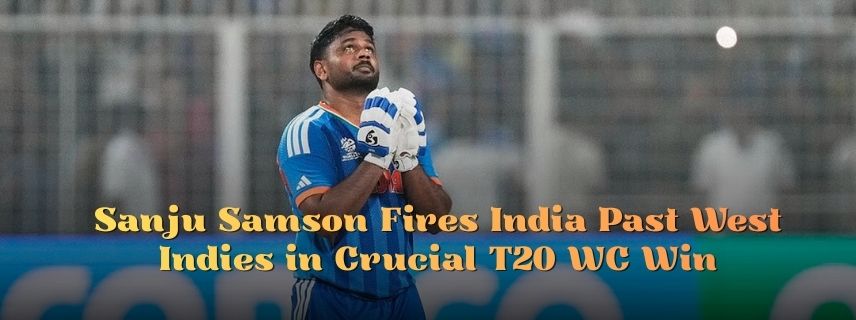
Sanju Samson Powers India Into T20 World Cup 2026 Semi-Final With Stunning Unbeaten 97
Sanju Samson has answered his critics in the most emphatic fashion possible. The wicketkeeper-batter, who had lost his place in India's T20 World Cup 2026 squad on the eve of the tournament and was recalled only after India's Super 8s humiliation against South Africa, produced a match-winning unbeaten 97 to guide the co-hosts to a five-wicket victory over West Indies. Sanju Samson batted through the entire chase of 196, striking the winning runs himself — lifting his 50th delivery over mid-on with four balls to spare — in what was effectively a quarter-final to determine India's place in the semi-finals.
West Indies Post 195: Chase and Holder Power the Innings
Put in to bat by India, West Indies made a strong start. Roston Chase, opening in T20 internationals for the first time, powered partnerships of 68 off 53 balls with Shai Hope and a quick 34 off 16 with Shimron Hetmyer. Jasprit Bumrah then produced a decisive intervention, dismissing both Hetmyer and Hope in a single over to apply the brakes at a critical moment. Despite Hope's sluggish 32 off 33 balls dampening the momentum, Jason Holder and Rovman Powell injected aggression at the death, adding 76 off the last 35 balls to set India a demanding target of 196. West Indies were also let down by their own fielding, dropping three catches that would prove costly as the chase unfolded.
Sanju Samson Leads the Chase With Ice-Cool Authority
India's run-chase was built almost entirely on the broad shoulders of Sanju Samson. The 31-year-old from Kerala walked in under pressure and never looked back, anchoring the innings with a blend of elegant stroke-play, sharp running, and calculated aggression. Sanju Samson's ability to rotate strike and find boundaries at key moments ensured India never fell too far behind the required rate. Despite the magnitude of the occasion and the weight of expectation on a co-host nation, Sanju Samson appeared completely unaffected, finishing unbeaten and sealing the win in style. It was a knock that will be remembered as one of the finest innings of his international career.
India vs England: A Blockbuster Semi-Final in Mumbai
With the victory confirmed, India set up a much-anticipated semi-final against England at Mumbai on Thursday — the third time these two sides have met at this stage of a T20 World Cup. The history between them makes this fixture even more compelling: in the past two tournaments, the winner of the India vs England semi-final has gone on to lift the trophy. England triumphed in Adelaide in 2022 and India prevailed in Guyana two years ago. Both sides will know exactly what is at stake when they walk out in Mumbai, with a place in the final on the line.
New Zealand vs South Africa in the Other Semi-Final
The other semi-final on Wednesday will pit New Zealand against South Africa. The Proteas secured top spot in their Super 8s group by defeating Zimbabwe by five wickets in Delhi, while New Zealand finished as runners-up in England's group. South Africa have a remarkable 100% record against New Zealand across five T20 World Cup encounters, though the two nations had not met in the tournament for 12 years before this edition. Sanju Samson's match-winning knock on Sunday means both semi-final pairings are now confirmed, with India eager to replicate their Guyana success.
Tournament Organisation Under the Spotlight
While Sanju Samson's brilliance lit up the night, the tournament's organisational challenges have cast a shadow over the event's final stages. The semi-final venues were confirmed only at the last minute after Pakistan failed to beat Sri Lanka by a sufficient margin on Saturday, leaving the possibility of relocation to Colombo alive until the very end. Tickets for semi-finals went on sale only the previous Tuesday, and two separate finals in two countries were simultaneously announced. The ICC's decision not to schedule the final round of Super 8s fixtures simultaneously across both groups drew sharp criticism, as staggered scheduling stretched across three days added to the confusion for fans, hoteliers, and organisers alike. India in particular faced logistical challenges as co-hosts, having played their first seven games across six different cities to satisfy fan demand nationwide. Despite all of that, Sanju Samson ensured that on the field at least, India delivered exactly what their fans needed.