
News
South Africa T20 World Cup Exit: Proteas Outclassed by New Zealand in Kolkata
5 Mar 2026, 4:08 pm
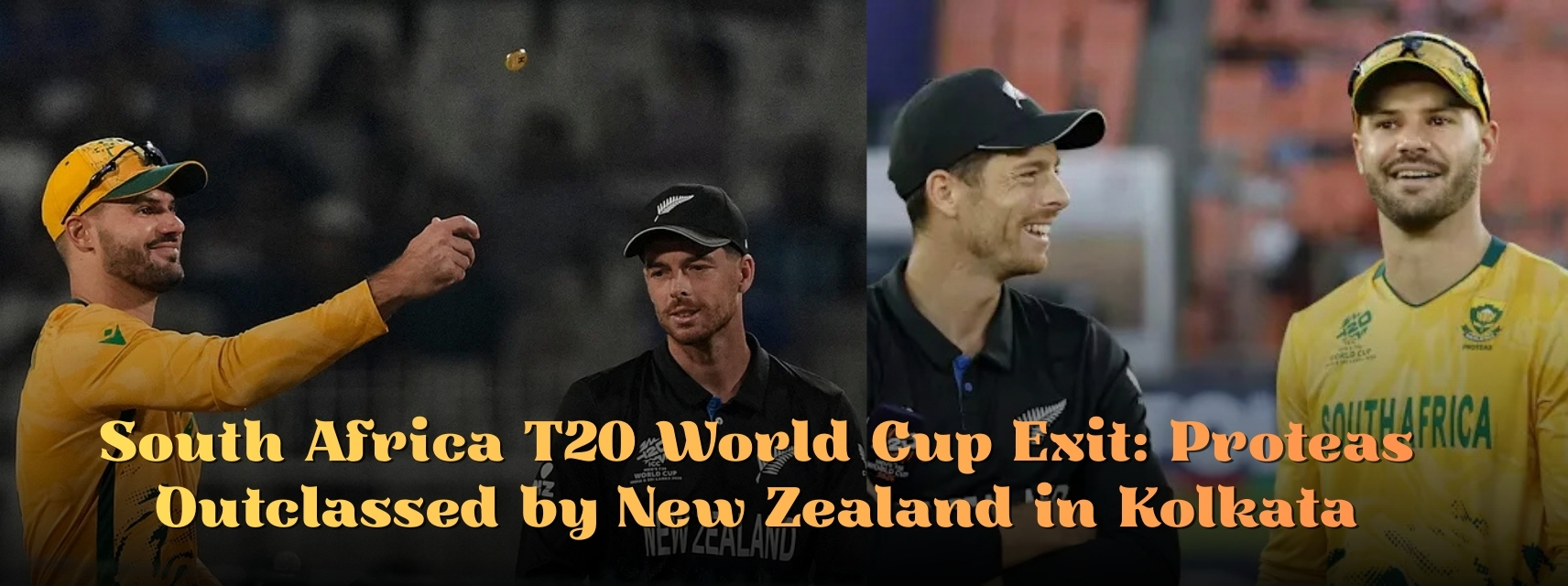
The South Africa T20 World Cup exit came with brutal clarity in Kolkata as New Zealand dismantled the Proteas in a one-sided semi-final at Eden Gardens. A record-breaking innings from Finn Allen ensured the Black Caps advanced to the final while South Africa’s impressive tournament run ended abruptly.
Coach Shukri Conrad did not hide behind familiar narratives after the defeat. Instead, he acknowledged that South Africa were comprehensively outplayed across all phases of the contest.
Finn Allen Masterclass Seals South Africa T20 World Cup Exit
New Zealand’s victory was built around a stunning display from opener Finn Allen, whose explosive century turned a competitive chase into a procession. The right-hander’s innings became the fastest hundred in Men’s T20 World Cup history and left the South African attack with few answers.
Allen’s assault quickly neutralised the Proteas’ bowling strategy, which had been one of the tournament’s most effective units. By the time the chase ended, New Zealand had completed a nine-wicket win that underlined the scale of South Africa’s T20 World Cup exit.
The defeat was particularly striking given South Africa’s form entering the knockout stage. The Proteas arrived at the semi-final unbeaten in seven matches, carrying momentum built through consistent batting and disciplined bowling.
Conrad Rejects ‘Choking’ Narrative
South Africa’s history in ICC knockout matches inevitably prompted questions about whether the latest defeat represented another case of choking. Conrad dismissed that interpretation bluntly, arguing that the result reflected outright dominance from New Zealand rather than a psychological collapse.
According to the coach, choking implies a contest that was within reach. In this case, South Africa rarely looked capable of wresting control from a side that executed its plans with clinical precision.
His candid assessment captured the frustration within the Proteas camp but also acknowledged the reality of elite knockout cricket. When a rival produces a performance of rare attacking clarity, even a well-prepared team can find itself overwhelmed.
Tournament Positives for the Proteas
Despite the South Africa T20 World Cup exit, the tournament contained several encouraging individual performances. Captain Aiden Markram emerged as one of the competition’s most productive batters, accumulating 286 runs during a campaign that reinforced his importance to the side’s white-ball plans.
The bowling group also delivered sustained impact throughout the group stage. Lungi Ngidi finished among the leading wicket-takers with 12 scalps, while Marco Jansen and Corbin Bosch contributed 11 wickets each to maintain South Africa’s reputation as a formidable pace unit.
Those contributions helped propel the Proteas into the semi-finals despite modest expectations before the tournament. Their progression suggested a team beginning to rebuild confidence after an inconsistent run of form prior to the competition.
Fallout and Future Direction
Even so, the South Africa T20 World Cup exit will inevitably trigger renewed scrutiny of the team’s ability to convert strong campaigns into silverware. South African cricket has long grappled with the narrative of near-misses in global tournaments, and another semi-final defeat will invite familiar criticism.
Conrad appeared prepared for that reaction, acknowledging that external judgement often arrives swiftly after a knockout loss. The coach’s focus instead remained on the broader trajectory of a squad that exceeded expectations to reach the last four.
For South Africa, the challenge now is ensuring that the lessons of Kolkata translate into long-term progress. A team capable of dominating the group stage must eventually discover how to carry that authority into the tournament’s decisive moments.
Coach Shukri Conrad did not hide behind familiar narratives after the defeat. Instead, he acknowledged that South Africa were comprehensively outplayed across all phases of the contest.
Finn Allen Masterclass Seals South Africa T20 World Cup Exit
New Zealand’s victory was built around a stunning display from opener Finn Allen, whose explosive century turned a competitive chase into a procession. The right-hander’s innings became the fastest hundred in Men’s T20 World Cup history and left the South African attack with few answers.
Allen’s assault quickly neutralised the Proteas’ bowling strategy, which had been one of the tournament’s most effective units. By the time the chase ended, New Zealand had completed a nine-wicket win that underlined the scale of South Africa’s T20 World Cup exit.
The defeat was particularly striking given South Africa’s form entering the knockout stage. The Proteas arrived at the semi-final unbeaten in seven matches, carrying momentum built through consistent batting and disciplined bowling.
Conrad Rejects ‘Choking’ Narrative
South Africa’s history in ICC knockout matches inevitably prompted questions about whether the latest defeat represented another case of choking. Conrad dismissed that interpretation bluntly, arguing that the result reflected outright dominance from New Zealand rather than a psychological collapse.
According to the coach, choking implies a contest that was within reach. In this case, South Africa rarely looked capable of wresting control from a side that executed its plans with clinical precision.
His candid assessment captured the frustration within the Proteas camp but also acknowledged the reality of elite knockout cricket. When a rival produces a performance of rare attacking clarity, even a well-prepared team can find itself overwhelmed.
Tournament Positives for the Proteas
Despite the South Africa T20 World Cup exit, the tournament contained several encouraging individual performances. Captain Aiden Markram emerged as one of the competition’s most productive batters, accumulating 286 runs during a campaign that reinforced his importance to the side’s white-ball plans.
The bowling group also delivered sustained impact throughout the group stage. Lungi Ngidi finished among the leading wicket-takers with 12 scalps, while Marco Jansen and Corbin Bosch contributed 11 wickets each to maintain South Africa’s reputation as a formidable pace unit.
Those contributions helped propel the Proteas into the semi-finals despite modest expectations before the tournament. Their progression suggested a team beginning to rebuild confidence after an inconsistent run of form prior to the competition.
Fallout and Future Direction
Even so, the South Africa T20 World Cup exit will inevitably trigger renewed scrutiny of the team’s ability to convert strong campaigns into silverware. South African cricket has long grappled with the narrative of near-misses in global tournaments, and another semi-final defeat will invite familiar criticism.
Conrad appeared prepared for that reaction, acknowledging that external judgement often arrives swiftly after a knockout loss. The coach’s focus instead remained on the broader trajectory of a squad that exceeded expectations to reach the last four.
For South Africa, the challenge now is ensuring that the lessons of Kolkata translate into long-term progress. A team capable of dominating the group stage must eventually discover how to carry that authority into the tournament’s decisive moments.